



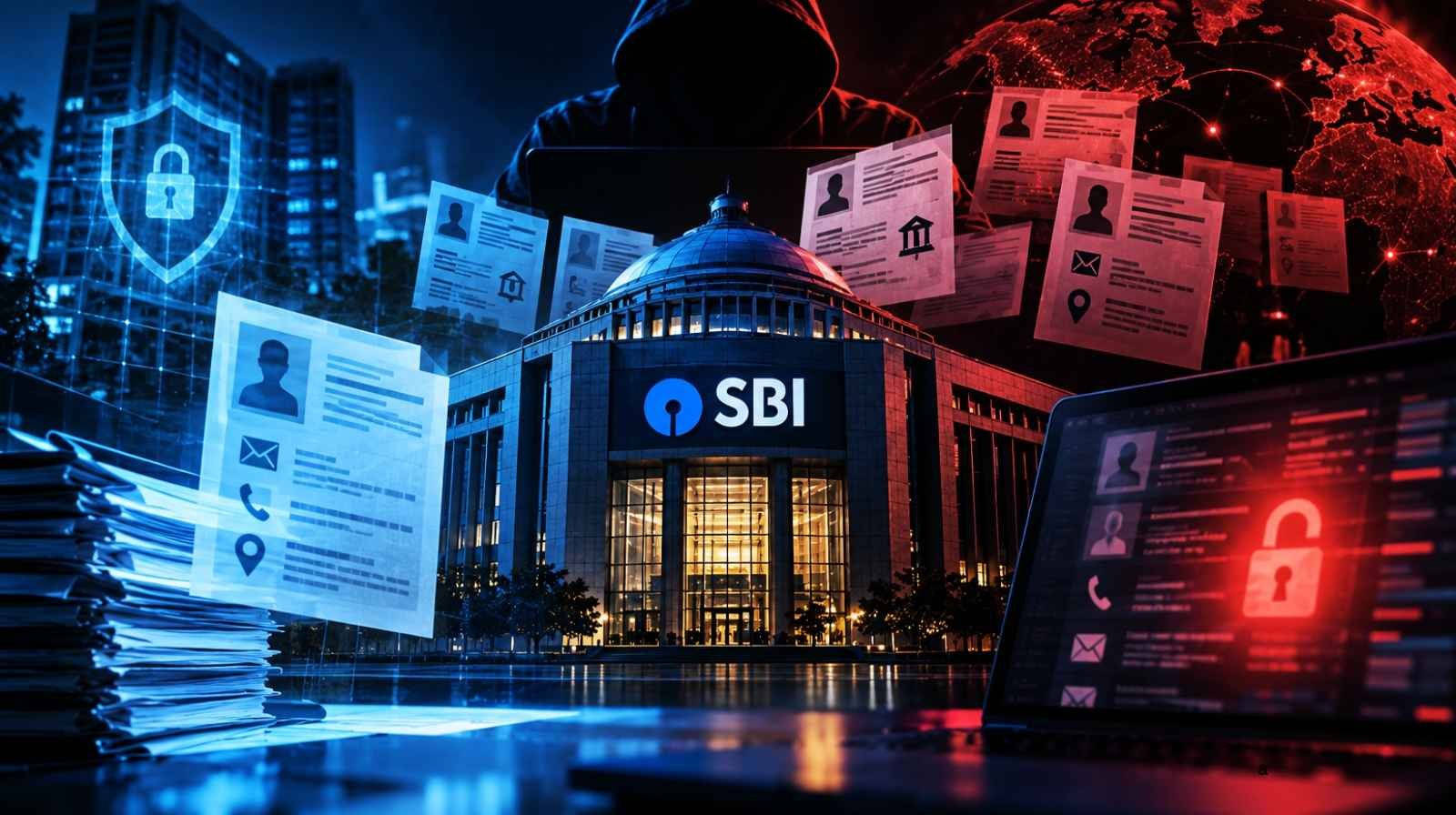
On October 21, 2026, State Bank of India (SBI) disclosed a cybersecurity incident involving customer information found in a dataset circulating on the dark web. According to reporting on the bank’s regulatory disclosure, preliminary analysis identified 3,897 customer records containing personally identifiable information (PII) within approximately 375,000 records.
The exposed information reportedly included names, mobile numbers, dates of birth, email addresses, residential addresses, customer identifiers, and metadata associated with loan and lead records. SBI stated that the incident was not expected to have a material impact on its core business operations or financial performance. The bank also engaged an independent cybersecurity agency to investigate the incident.
The incident highlights an important challenge for financial institutions: protecting core banking systems is not enough if customer information is also stored, processed, or shared through loan origination platforms, customer acquisition systems, third party vendors, and other supporting infrastructure.
For security teams, the priority is to establish the origin and scope of the exposure, identify affected systems and identities, contain unauthorized access, and reduce the risk of follow on fraud.
What Happened in the SBI Data Exposure Incident?
The incident became public after a threat actor using the alias Siriusim reportedly advertised a dataset associated with SBI on BreachForums on October 16, 2026.
The listing allegedly included approximately 375,000 records and 2,722 PDF documents described as customer or loan related files. These figures originated from the threat actor’s claims and should not be interpreted as independently verified counts of compromised customer files.
SBI subsequently acknowledged an incident involving the loss of certain data. Its preliminary examination identified 3,897 customer records containing PII in the larger dataset. The bank initiated incident response procedures and appointed an independent cybersecurity agency to investigate the nature, source, and extent of the exposure.
The distinction between the larger dataset and the records identified as containing PII is important. The 375,000 figure describes the approximate volume of records examined, whereas 3,897 refers to the customer records identified as containing personal information during the preliminary analysis. The investigation had not established all the details of the incident’s origin or full scope in the available reporting.
Incident Timeline
October 16, 2026: SBI reportedly received alerts from its threat intelligence provider, the Defence Cyber Agency, and CERT-In concerning suspected customer data exposure on the dark web.
October 16 to 20, 2026: The alleged dataset attracted public attention, while investigators and analysts examined information associated with the listing.
October 21, 2026: SBI disclosed the incident to the stock exchanges and reported that preliminary analysis had identified 3,897 customer records containing PII.
Following the disclosure: The bank’s investigation and assessment of the incident continued, with an independent cybersecurity agency engaged to establish the extent and potential source of the exposure.
The timeline reflects publicly reported information. The precise initial access method, complete data provenance, and root cause should not be treated as established until supported by forensic findings.
What Information Was Reportedly Exposed?
The information identified in public reporting creates risks beyond the immediate loss of confidentiality. Personal details can be combined with other information to make fraudulent communications appear credible.
The reported categories include:
| Data Category | Examples | Potential Security Impact |
|---|---|---|
| Personal information | Names, dates of birth, gender | Identity impersonation and targeted fraud |
| Contact information | Mobile numbers, email addresses, residential addresses | Phishing, smishing, and vishing |
| Banking identifiers | Branch details and customer identifiers | More convincing impersonation attempts |
| Loan related information | Lead identifiers and loan metadata | Targeted financial scams and potential identity misuse |
| Supporting documents | PDF files claimed by the threat actor | Potential exposure of additional personal information, subject to verification |
| The presence of these information categories does not establish that every listed field appeared in every affected record. The precise contents and completeness of the dataset remain matters for forensic verification. |
Why Customer Identifiers Matter
An attacker does not necessarily need a banking password to make use of exposed customer information.
A combination of a person’s name, telephone number, branch information, and knowledge of a loan application can make an unsolicited call sound legitimate. The attacker may then attempt to persuade the individual to disclose an OTP, approve a transaction, install remote access software, or provide additional identity documents.
This is why data exposure incidents can lead to secondary fraud even when the initial incident does not directly compromise transaction processing.
What Is Known About the Impact on SBI?
SBI’s reported disclosure indicated that the incident was not expected to have a material impact on its core business operations or financial performance. Public reporting also stated that the bank had initiated an investigation and engaged an independent cybersecurity agency.
However, three questions must be assessed separately.
Customer data confidentiality: Personal information was identified in the dataset circulating on the dark web.
Core banking integrity and availability: The bank reported no expected material impact on its core business operations. This does not, by itself, establish the security status of every system, credential, or supporting application.
Downstream fraud risk: Exposed personal information may be used in targeted scams or identity misuse, regardless of whether the core banking environment was affected.
A reliable assessment should avoid equating the absence of a reported material operational impact with the absence of customer risk. Confidentiality, integrity, and availability are distinct dimensions of cybersecurity.
Potential Attack Paths: What Financial Institutions Should Investigate
The public information available does not establish the exact technical entry point responsible for the SBI exposure. Nevertheless, the incident provides a useful basis for examining common risk areas across financial services environments.
The following scenarios are investigation hypotheses, not confirmed explanations of the SBI incident.
1. Third Party Vendors and Loan Sourcing Partners
Financial institutions frequently work with direct selling agents, fintech companies, document processing providers, and other external organizations that handle customer onboarding information.
These relationships can create additional copies of sensitive records outside the primary banking environment. A poorly secured cloud repository, excessive vendor permissions, or an inadequately monitored file transfer process can expose information even when the central banking platform remains secure.
Security teams should maintain an inventory of third parties that process personal information, validate their access permissions, monitor external exposure, and enforce contractual security requirements.
2. Loan Origination APIs and Customer Onboarding Applications
Digital loan applications depend on APIs and supporting services to exchange customer information between websites, mobile applications, internal systems, and external providers.
Weak object level authorization, excessive permissions, inadequate input validation, or improperly configured endpoints can expose records to unauthorized users.
Defensive reviews should verify that every API request is authorized for the specific customer and resource involved. Security testing should also cover access control, authentication, rate limiting, logging, and sensitive data handling.
3. Compromised Employee or Administrative Identities
Compromised email accounts, stolen credentials, and excessive privileges can provide access to sensitive customer files without requiring an attacker to compromise the core banking ledger.
Financial institutions should investigate suspicious sign ins, unusual file access, abnormal downloads, unexpected privilege changes, and data transfers that deviate from established behavioral patterns.
Multifactor authentication, phishing resistant authentication where appropriate, privileged access management, and continuous identity monitoring can reduce the likelihood and impact of account compromise.
4. Unprotected Staging Databases and Document Repositories
Customer information is often copied into temporary databases, document repositories, reporting environments, and application staging areas.
These locations can become attractive targets if encryption, access restrictions, retention controls, and monitoring are weaker than those applied to production systems.
Organizations should identify where sensitive information is stored, minimize unnecessary copies, remove data that is no longer required, and apply consistent security controls throughout the data lifecycle.
How Exposed Banking Data Can Lead to Secondary Fraud
The potential consequences of a data exposure incident can extend well beyond the original event. Financial institutions and affected customers should consider several downstream risks.
Targeted Phishing and Vishing
Attackers may use exposed information to personalize fraudulent emails, text messages, or telephone calls. References to a real branch, loan application, customer identifier, or personal detail can make a fraudulent request appear authentic.
Organizations should monitor impersonation campaigns, communicate through verified channels, and remind customers never to disclose OTPs, UPI PINs, passwords, or other authentication secrets in response to unsolicited requests.
Identity Theft and Fraudulent Credit Applications
If supporting identity documents or financial application details are exposed, criminals may attempt to reuse that information in fraudulent applications or combine it with information obtained from other sources.
Financial institutions and lending providers should strengthen identity verification, detect duplicate or inconsistent application details, and monitor suspicious changes to customer contact information.
The availability of personal information alone does not prove that fraudulent applications have occurred. Such activity should be investigated using transaction, identity, and application telemetry.
SIM Swap and Account Takeover Attempts
An attacker may attempt to exploit personal information in a fraudulent SIM replacement or account recovery process. If the attacker succeeds in taking control of a victim’s telephone number or recovery channel, some authentication workflows may become vulnerable.
Telecommunications providers and financial institutions should strengthen identity verification for sensitive account changes and monitor unusual changes to telephone numbers, recovery factors, and authentication patterns.
Fraudulent Customer Support Interactions
Exposed customer identifiers can help criminals impersonate bank employees or fraud investigators. Customers may be pressured into sharing authentication information or authorizing transactions under the pretext of protecting their accounts.
Financial institutions should establish clear customer communication policies and monitor unusual transaction patterns that may indicate coercion or social engineering.
How Banks Can Detect and Contain Similar Data Exposures
The SBI incident illustrates why detection capabilities must extend beyond the core banking network.
Monitor Identity and User Behavior
Security operations teams should correlate authentication events, account privileges, file access, application activity, and data transfers. Unusual activity by a legitimate account may indicate credential compromise or misuse of authorized access.
Behavioral analytics can help identify deviations from normal activity, including unexpected access to sensitive records, unusual download volumes, and abnormal activity involving privileged identities.
Correlate Security Events Across Systems
A suspicious sign in may not be sufficient to establish an incident. However, when it occurs alongside an unexpected privilege change, access to a customer database, and an unusual outbound transfer, the combined evidence can justify a higher investigation priority.
Security teams should correlate identity, endpoint, network, cloud, application, and data access events to establish the sequence of activity and determine the potential scope of exposure.
Investigate Potential Data Exfiltration
Organizations should monitor unusual data access and transfer patterns, particularly those involving customer databases, document repositories, cloud storage, and third party integrations.
Useful signals include abnormal download volumes, access outside expected working patterns, unusual destinations, bulk queries, and activity inconsistent with an account’s normal responsibilities.
Detection rules should account for legitimate business activity to minimize false positives. Alerts should be assessed using contextual evidence rather than isolated thresholds alone.
Strengthen Third Party Security
Vendor risk management should extend beyond periodic questionnaires and compliance assessments.
Financial institutions should validate access controls, review security configurations, assess exposed infrastructure, monitor vendor identities, and verify that third parties meet defined security and data handling requirements.
Access should be limited to the information and systems required for each business purpose, with appropriate expiration and review processes.
Apply Data Minimization and Encryption
Sensitive information should be collected only when necessary and retained only for an appropriate period.
Encryption at rest and in transit, field level protection, tokenization, and controlled key management can reduce the consequences of unauthorized access. These measures should complement strong authorization and monitoring controls, rather than replace them.
Prepare Incident Response and Customer Protection Procedures
Incident response plans should define how teams preserve evidence, determine scope, contain unauthorized access, coordinate with affected providers, and communicate with customers and regulators.
Where customer information has been exposed, organizations should assess the likelihood of misuse and issue accurate, timely guidance through verified channels.
A Practical Security Checklist for Financial Institutions
Use this checklist to assess whether your organization has adequate safeguards across customer data and supporting systems.
Data Protection
☐ Maintain an inventory of sensitive customer information and where it is stored.
☐ Encrypt and tokenize sensitive records, and establish clear data retention policies.
☐ Monitor bulk downloads and unusual access to customer data.
Identity Security
☐ Enforce multifactor authentication and least privilege access.
☐ Monitor unusual sign ins, privilege escalation, and suspicious account activity.
☐ Regularly review employee, service account, vendor, and administrator permissions.
Application and API Security
☐ Verify that users can access only the customer records they are authorized to view.
☐ Test API authentication, authorization, and rate limiting.
☐ Secure document repositories, cloud storage, and application staging environments.
Third Party Risk
☐ Maintain an inventory of vendors that process sensitive customer information.
☐ Regularly assess vendor access permissions, cloud configurations, and data transfer controls.
☐ Revoke third party access when it is no longer required.
Detection and Incident Response
☐ Correlate identity, endpoint, network, application, and data access logs.
☐ Establish procedures for investigating and containing suspected data exfiltration.
☐ Define customer notification and regulatory escalation procedures.
How Gurucul Can Help Defend Against Similar Threat Scenarios
Preventing and investigating customer data exposure requires visibility across identities, applications, infrastructure, and user behavior. The following Gurucul products address complementary parts of the detection, investigation, and response process.
Gurucul Next-Gen SIEM
Gurucul Next-Gen SIEM helps security operations teams correlate security events and identify suspicious activity across their environments. For potential banking data exposure, it can support investigations into unusual authentication events, unauthorized access to customer records, unexpected privilege changes, and suspicious data transfers.
By bringing security telemetry together, teams can investigate related events in context and prioritize incidents that require further analysis.
Gurucul User and Entity Behavior Analytics (UEBA)
Gurucul UEBA helps identify anomalous behavior involving employees, service accounts, privileged identities, and other entities. Relevant use cases include detecting unusual access to sensitive customer records, abnormal download activity, and deviations from established user or entity behavior.
These insights can help security teams investigate potentially compromised identities and distinguish suspicious activity from normal business operations.
Gurucul AI Risk and Response
Gurucul AI Risk and Response helps organizations identify and assess risks involving enterprise AI applications, agents, identities, and data interactions.
For financial institutions, it is relevant to scenarios in which employees or AI agents might expose confidential customer information through unauthorized AI tools or excessive access permissions. It can help security teams connect AI activity with identity and security context to investigate emerging risks.
This is a related AI security use case, not evidence that AI systems were involved in the SBI incident.
Gurucul AI-Powered Insider Risk Management
Gurucul AI-Powered Insider Risk Management can support the identification and investigation of risky user behavior involving sensitive business information.
In financial services environments, relevant scenarios include unusual customer data access, suspicious file handling, excessive use of privileges, and potentially unauthorized movement of confidential information. Behavioral context can help security teams prioritize investigations and assess whether activity warrants further action.
Bringing the Capabilities Together
Gurucul Next-Gen SIEM supports security event correlation and investigation. UEBA adds behavioral context to suspicious activity involving users and other entities. AI Risk and Response extends risk visibility to enterprise AI applications and agents, while AI-Powered Insider Risk Management focuses on potentially risky behavior involving sensitive information.
Together, these products can support a layered security strategy when deployed with appropriate integrations, telemetry, detection rules, and response procedures. They complement, rather than replace, secure application design, data governance, encryption, third party oversight, and a tested incident response program.
No individual product can guarantee that a breach will be prevented or detected. Effective defense also requires secure application design, appropriate data governance, access controls, encryption, third party oversight, and a tested incident response program.
Key Takeaways for CISOs and Security Leaders
The SBI data exposure reinforces several lessons for financial services cybersecurity.
First, customer information can be exposed through supporting systems even when the core banking environment continues to operate.
Second, personal information and customer identifiers can enable targeted fraud without directly revealing transaction credentials.
Third, third party access, application APIs, document repositories, and administrative identities deserve the same rigorous security attention as production banking systems.
Fourth, security teams need to correlate events across identity, application, endpoint, network, and data environments to investigate suspicious activity effectively.
Finally, incident communication must distinguish confirmed findings from allegations and investigative hypotheses. Accurate reporting protects customers, supports regulatory accountability, and helps security teams focus on the risks that evidence actually supports.
The broader lesson is clear: protecting financial services requires visibility across the complete customer data lifecycle, not only the systems responsible for processing transactions.
Frequently Asked Questions
How many SBI customer records were identified in the data exposure?
SBI’s preliminary analysis identified 3,897 customer records containing personally identifiable information within a larger dataset of approximately 375,000 records reported to be circulating on the dark web.
Was SBI’s core banking system affected?
SBI stated that the incident was not expected to have a material impact on its core business operations or financial performance. The full technical scope and origin of the data exposure required further investigation.
What information was reportedly exposed?
Reported information included names, mobile numbers, dates of birth, email addresses, residential addresses, customer identifiers, and loan or lead related metadata. The exact contents of individual records require verification.
What are the main risks associated with exposed banking data?
Potential risks include targeted phishing, telephone impersonation, identity misuse, fraudulent credit applications, and attempts to take over customer accounts. These are possible consequences, not proof that each form of fraud occurred in this incident.
How can banks detect customer data exposure?
Banks can correlate identity activity, application logs, database access, endpoint telemetry, network traffic, and data transfer events. Behavioral analytics, SIEM, access monitoring, and incident response procedures can help investigators identify suspicious activity and determine its scope.
How can Gurucul help financial institutions?
Gurucul offers security analytics and risk management capabilities that can support event correlation, behavioral analysis, incident investigation, and response coordination. The relevant coverage depends on integrations, available telemetry, configuration, and organizational response procedures.
Sources and Further Reading
- SBI, Subsidiaries’ Customer Data Allegedly On Dark Web: 3.75 Lakh Records, 2,722 Documents Claimed In Data Breach, Free Press Journal.
https://www.freepressjournal.in/business/sbi-subsidiaries-customer-data-allegedly-on-dark-web-375-lakh-records-2722-documents-claimed-in-data-breach - SBI flags dark web exposure of 3,897 customer records; names, mobile numbers, addresses among data leaked, The Economic Times.
https://m.economictimes.com/industry/banking/finance/banking/sbi-flags-dark-web-exposure-of-3897-customer-records-names-mobile-numbers-addresses-among-data-leaked/articleshow/135081335.cms - State Bank of India confirms cyberattack, data of 3,900 customers exposed on dark web, Livemint.
https://www.livemint.com/industry/banking/state-bank-of-india-confirms-cyberattack-data-of-3-900-customers-exposed-on-dark-web-all-you-need-to-know-11792555529603.html - SBI data leak: 3,897 customer records identified on dark web; bank launches probe, Financial Express.
https://www.financialexpress.com/business/industry-sbi-flags-suspected-data-leak-involving-3897-customer-records-found-on-dark-web-4366055/ - Gurucul Next-Gen SIEM.
https://gurucul.com/products/next-gen-siem/ - Gurucul User and Entity Behavior Analytics (UEBA).
https://gurucul.com/products/user-and-entity-behavior-analytics-ueba/ - Gurucul AI Risk and Response.
https://gurucul.com/products/gurucul-ai-risk-and-response/ - Gurucul AI-Powered Insider Risk Management.
https://gurucul.com/products/ai-powered-insider-risk-management/