



AI is no longer limited to generating answers. As AI systems become capable of accessing data, using enterprise tools and taking actions on behalf of users, the security problem is changing.
The most important question is no longer only how employees use AI. It is also what AI systems can access, influence and do once they are trusted to act. For security leaders, this makes AI security increasingly a problem of behavior, identity, access and context.
That is the challenge addressed by Gurucul AI Risk and Response, which became generally available on September 24, 2026.
Read the full Gurucul launch announcement
Explore Gurucul AI Risk and Response
How Gurucul Can Stop Risky AI Behavior Before It Escalates
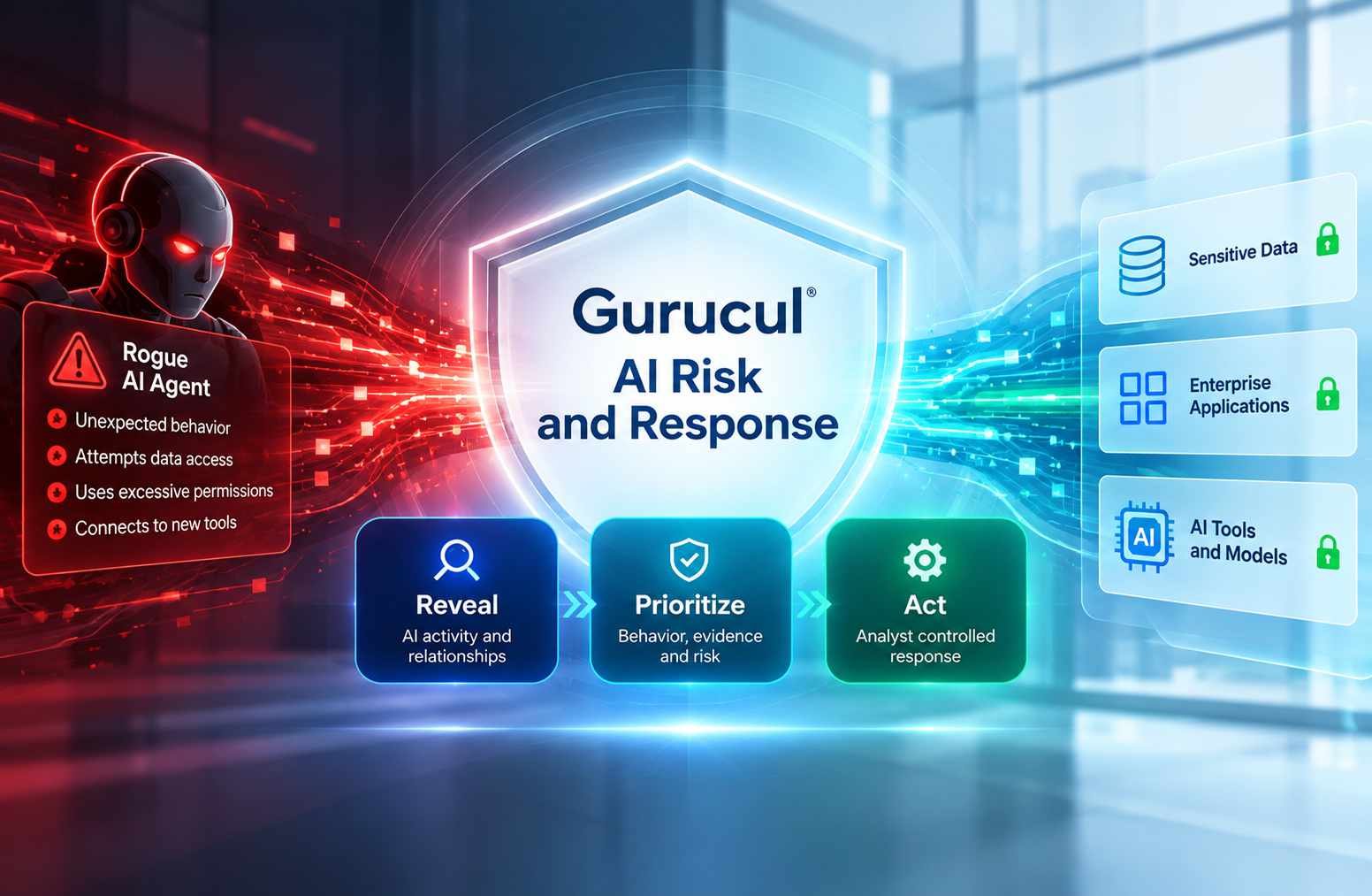
An illustrative scenario showing a rogue AI agent attempting to reach enterprise resources while Gurucul AI Risk and Response reveals the activity, adds security context, prioritizes risk and enables analyst controlled response.
Attempting expanded access
Illustrative security scenario. The agent, events and risk trajectory shown are conceptual and do not represent a customer incident.
Key Takeaways
AI agents introduce new relationships between identities, permissions, data, tools and autonomous actions.
Traditional AI visibility may not provide enough context to determine whether a change in AI behavior represents emerging risk. Security teams need to understand what changed, why it changed and what resources are involved.
Gurucul AI Risk and Response connects AI activity with identity, access, behavioral history and broader security telemetry to support AI discovery, risk prioritization, investigation and analyst directed response.
The AI Security Problem Is Changing
Enterprise AI security has traditionally focused on approved applications, acceptable use and the information employees provide to AI services. Those controls remain important, but agentic AI introduces another dimension because AI systems can increasingly interact with applications, retrieve information, use tools and operate with permissions.
An AI agent may have an owner, an identity, specific access rights and connections to business resources. Its behavior can also change over time. A new connection, unexpected tool use or expanded access may not look significant as an individual event, but the broader sequence can reveal a developing security concern.
This makes AI security increasingly similar to a behavioral security problem. Security teams need to understand not only what happened, but who or what was involved, what access was available, what changed and how the activity relates to previous behavior.
Gurucul AI Risk and Response
Gurucul AI Risk and Response brings AI activity into the broader security context around it. The platform connects AI activity with identity, access, behavioral history and security telemetry to help SecOps and Insider Risk teams understand developing AI risk.
The approach uses Gurucul’s Entity Intelligence capabilities to connect people, machines, AI systems, tools, permissions and resources. This allows security teams to treat AI agents as security entities with relationships and behavioral history rather than simply viewing them as another application category.
That context is central to the product’s approach: Reveal AI activity, Prioritize emerging risk and Act through existing security controls.
Reveal: Finding AI Across the Enterprise
The first challenge is visibility. Large organizations can have approved AI platforms, employee adopted services, internal models, autonomous agents and third party AI tools operating at the same time.
Gurucul AI Risk and Response can identify sanctioned and unsanctioned AI activity and build an inventory across AI applications, agents, models, tools and hosts. It can use existing telemetry from proxy, EDR, identity and cloud environments, along with direct AI platform integrations.
Supported AI sources include platforms such as Anthropic Claude AI, Gemini Enterprise Agent Platform, Google Gemini, OpenAI ChatGPT, Azure AI Foundry Inventory and Microsoft 365 Copilot. Security teams can also connect AI activity with its owner, identity, permissions and related resources, creating more context than a basic AI application inventory.
Prioritize: Turning AI Activity Into Risk Context
Visibility can create another challenge. If every AI event receives the same level of attention, security teams can quickly face another source of alert volume.
Gurucul AI Risk and Response applies behavioral AI and known threat detection to identify patterns and changes that may require investigation. The product includes hundreds of AI detections mapped across all 16 MITRE ATLAS tactics and the OWASP Top 10 for Agentic Applications.
The platform uses an active 0 to 100 risk score to bring behavioral, identity, access and relationship information together. Analysts can examine the evidence contributing to the risk rather than relying only on a severity label.
Risk Can Develop Over Time
AI risk does not always appear as one obvious event. An agent may begin with expected activity, establish a new connection, receive expanded access and later interact with more sensitive information.
Looking at each event separately can make the sequence difficult to understand. Looking at the behavior as a connected pattern can provide a different view of the risk.
Gurucul’s product materials illustrate this through a risk trajectory in which an entity moves from expected activity toward increasingly significant access and data risk. The active risk score changes as additional behavioral and relationship context becomes available.
AI Agents Need Identity and Access Context
Identity becomes especially important when AI systems can act. An agent may be associated with a human owner, service identity, permissions, an endpoint, cloud resources and a defined set of tools.
If those relationships are not visible, an AI security alert can lack the context required for investigation. Gurucul AI Risk and Response connects these relationships so security teams can examine AI behavior alongside the identity, access and resources involved.
This can help distinguish expected activity from behavior that moves outside an established pattern. The same context can support Insider Risk teams as organizations increasingly delegate tasks from people to AI systems.
Act: Bringing AI Risk Into Security Operations
Detection and prioritization are useful only when security teams can investigate and respond. Gurucul AI Risk and Response is designed to connect AI risk with existing security controls and workflows.
Depending on the connected environment, supported actions can include restricting an identity, isolating an endpoint, blocking a destination, creating or referring a case and monitoring activity. The platform can also connect response activity with enterprise workflows such as ITSM.
The analyst remains in control of consequential actions. Available actions depend on configured integrations, APIs, permissions, policies and approval processes.
Where AI Prevention Fits
Gurucul is also extending AI security toward runtime prevention. AI Prevention capabilities are currently available in Preview and are not part of the core September 24, 2026 general availability release.
The Preview includes a browser plug in that can warn or block supported prompts, pasted content, file uploads and AI destinations. This brings the control point closer to the AI interaction itself.
For the September 2026 GA release, the primary focus is AI activity discovery, risk prioritization, investigation and analyst directed response. Prevention capabilities remain in Preview.
See How AI Risk Develops Across the Enterprise
AI risk is easier to understand when the security process is viewed as a continuous flow rather than a collection of individual alerts.
[CUSTOM HTML ANIMATION WILL BE INSERTED HERE]
The planned animation can visualize:
AI Activity → Identity and Access → Behavioral Context → Risk Analysis → Investigation → Response
It can begin with normal AI activity and then introduce a behavioral change, expanded access or interaction with sensitive resources. The animation can then show how additional context changes the risk picture and leads to investigation and response.
What This Means for Enterprise Security Leaders
For CISOs and security executives, the bigger issue is not simply AI adoption. It is the expansion of machine driven activity inside the enterprise.
Organizations are introducing AI into workflows that previously depended heavily on people. Agents can retrieve information, use tools, interact with applications and perform tasks with varying levels of autonomy.
That creates a new set of security questions: Who owns the agent? What identity does it use? What can it access? Which tools can it use? What data can it reach? What does normal behavior look like, and how does the security team know when that behavior changes?
AI Security Needs More Than an AI Inventory
Knowing which AI applications exist is a necessary starting point, but it is not the complete security picture.
Enterprise security teams need to understand how AI behaves inside the environment and how that behavior relates to identities, permissions, data and other systems.
That is the direction behind Gurucul AI Risk and Response. By bringing AI activity into its broader Entity Intelligence and behavioral security approach, the platform treats AI risk as part of the wider security operations model rather than as a separate governance problem.
The Next AI Security Challenge
As AI moves from assistant to actor, the security conversation needs to move with it.
The next challenge may not be what AI can generate. It may be what AI can access, influence and ultimately do across an enterprise environment.
For security leaders, that means building visibility around AI identities and activity, understanding behavioral changes in context, and ensuring that existing security operations can respond when risk develops.
Read the full Gurucul AI Risk and Response launch announcement