



The next insider threat may not be a person. It may be an AI agent, automation system, or machine identity operating with legitimate access.
That shift is becoming increasingly important as organizations adopt artificial intelligence, cloud platforms, automation, and non-human identities. Security teams are no longer dealing only with employees who intentionally or accidentally expose sensitive information. They must also understand what trusted digital identities are doing, why they are doing it, and whether their behavior creates meaningful risk.
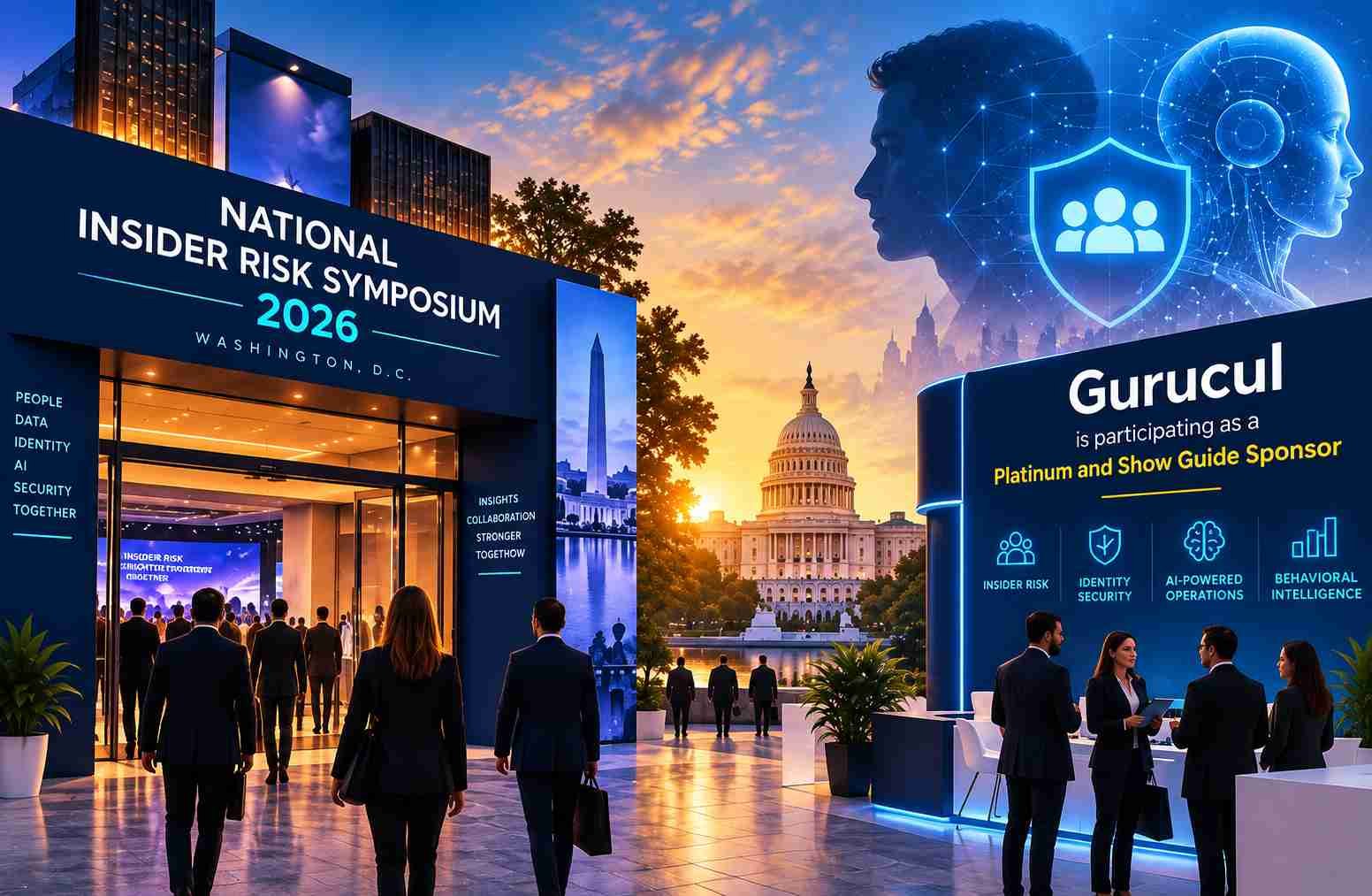
That makes the National Insider Risk Symposium 2026, taking place September 15–16 in Washington, D.C., particularly relevant. The 11th National Insider Risk Symposium will bring together leaders and experts from commercial and public-sector organizations to examine the evolving insider risk landscape, including emerging technologies, policies, and strategies for improving detection and mitigation.
The timing also aligns with a major finding from Gurucul’s 2026 Insider Risk Report: The Year AI Became an Insider. The report, produced in partnership with Cybersecurity Insiders, surveyed 725 IT and cybersecurity professionals and found that AI is becoming a significant factor in the insider risk equation.
What Is the National Insider Risk Symposium 2026?
The National Insider Risk Symposium 2026 is an insider-risk-focused cybersecurity event scheduled for September 15–16, 2026, in Washington, D.C.
The event focuses on the technologies, policies, and security strategies organizations need to identify, manage, and mitigate insider risk. Its broader approach is important because insider risk rarely fits neatly inside one security function.
HR teams may hold important workforce context. Security teams may see suspicious activity. IT teams control systems and access. Legal teams may oversee investigations and regulatory considerations.
Connecting those perspectives can help organizations move from isolated alerts toward a more complete understanding of risk.
The 2026 symposium is also expected to examine the growing impact of artificial intelligence on the workforce and insider-risk landscape. The event emphasizes collaboration, information sharing, detection, prevention, and more proactive approaches to insider risk.
Why AI Is Becoming an Insider Risk
Artificial intelligence changes the traditional insider-threat model because an AI system can operate with access that was originally granted to a human user or business process.
An AI assistant connected to corporate applications may have access to email, documents, calendars, databases, or other business systems. An autonomous workflow may also be able to make decisions or take actions without requiring a person to approve every individual step.
The security challenge is therefore not simply whether the AI is malicious.
The bigger question is whether the AI is operating within the organization’s expected boundaries.
Gurucul’s 2026 Insider Risk Report highlights this emerging problem. According to the report, 94% of organizations say AI is increasing their insider-risk exposure, while 74% describe that increase as moderate or significant. The report also identifies AI agents acting like digital employees as an emerging category of insider risk.
This changes the traditional question of insider security.
Instead of asking only, “Who has access?”, organizations increasingly need to ask:
What is this identity doing?
Why is it doing it?
Is the behavior normal for this identity?
Could the activity indicate a security or compliance risk?
These questions apply to employees, service accounts, machines, automation systems, and AI agents.
The Insider Risk Problem Is Already Widespread
AI is not creating insider risk from scratch. Instead, it is accelerating an existing problem.
Gurucul’s 2026 research found that only 10% of organizations reported zero insider incidents during the previous 12 months. That means 90% experienced at least one insider incident. The report also found that insider incidents can carry significant financial consequences, with more than half costing at least $500,000 to remediate.
The leading concern is not always a malicious employee.
According to the report, 74% of organizations rank negligent insiders as their top concern, compared with 59% for malicious actors.
This distinction matters in an AI-enabled enterprise.
An employee may unintentionally provide an AI system with excessive permissions. An automated process may move sensitive information into an inappropriate environment. An AI agent may perform an action that is technically authorized but inconsistent with normal business behavior.
None of these scenarios requires malicious intent.
Yet the resulting security impact can still be serious.
Why Behavioral Analytics Matters More Than Ever
Traditional security controls often focus on events, permissions, rules, and known indicators. Those controls remain important, but insider risk requires additional context.
Consider an employee who downloads a large number of files.
That activity might be completely normal for someone preparing for a legitimate project. It might also indicate data theft.
The difference is context.
Security teams need to understand factors such as the user’s normal behavior, role, access history, location, data sensitivity, device activity, identity signals, and other related events.
The same principle applies to AI agents and machine identities.
A service account making a particular API request may be normal. The same account suddenly accessing an unusual collection of sensitive resources could indicate risk.
Behavioral analytics helps security teams identify those deviations instead of treating every event as equally important.
Tool Sprawl Can Make Insider Risk Harder to Manage
Another challenge highlighted by the 2026 Insider Risk Report is security-tool fragmentation.
The report says that about one-third of organizations use five or more insider-risk tools, while roughly two-thirds continue to identify detection accuracy as a major challenge.
More tools do not automatically produce better visibility.
When identity, endpoint, cloud, data-loss prevention, HR, and security telemetry remain separated, analysts may have to manually connect information across multiple systems.
That creates delays.
It can also make it harder to distinguish a genuinely dangerous pattern from ordinary business activity.
For insider risk programs, the ability to correlate signals may therefore be just as important as the ability to generate alerts.
From Human Insiders to Human and Non-Human Identities
The definition of an insider is expanding.
Historically, the term usually referred to an employee, contractor, privileged user, or other person with legitimate organizational access.
Today, enterprises also depend on:
- Service accounts
- Bots
- Automated workflows
- Machine identities
- API-connected applications
- AI assistants
- Autonomous AI agents
These identities can have extensive permissions and can interact with sensitive systems at machine speed.
That creates a new security requirement: organizations need visibility across human and non-human identities.
Gurucul describes its AI-powered insider risk management approach as correlating activity across identity, access, location, endpoint, cloud, and business systems. Its platform also includes monitoring for machine identities and AI agents.
For security leaders, the broader lesson is straightforward.
Identity security cannot stop at the employee directory.
What Security Teams Should Watch for
Organizations preparing for the changing insider-risk landscape should focus on behavior and context rather than relying on isolated alerts.
Several areas deserve particular attention.
Unusual access patterns
Monitor for identities accessing systems, applications, or data outside their normal behavioral baseline.
Unexpected data movement
Look for unusual downloads, uploads, transfers, screenshots, printing, removable-media activity, or movement into personal cloud environments.
Privilege misuse
High-risk identities deserve additional scrutiny when they suddenly access sensitive resources or perform actions outside their normal responsibilities.
AI and automation activity
Track what AI agents and automated systems can access and what actions they perform. Permissions should be aligned with clearly defined business requirements.
Behavioral changes
A change in normal activity can be more meaningful than a single security event. Behavioral analytics can help identify those changes and prioritize them for investigation.
Cross-system signals
Insider risk rarely appears in one log source. Correlating identity, endpoint, cloud, data, and business context can provide a clearer picture of what is happening.
The Detection-Response Gap Is a Critical Issue
Detecting suspicious behavior is only one part of insider risk management.
Security teams must also be able to investigate and respond.
Gurucul’s research highlights a significant difference between organizations’ ability to perform triage and their ability to contain insider-risk events. Its analysis describes this as a detection-response gap, where identifying suspicious behavior does not always translate into rapid containment.
This is where automation can play an important role.
Automated workflows can help security teams prioritize alerts, enrich investigations, apply predefined controls, and escalate higher-risk cases. However, automation should operate within appropriate governance and risk boundaries.
The goal is not to remove human oversight.
The goal is to help security professionals spend more time on complex decisions and less time manually processing repetitive signals.
Why the National Insider Risk Symposium 2026 Matters
The National Insider Risk Symposium 2026 arrives at a point when the insider-risk conversation is moving beyond traditional employee monitoring.
The emerging discussion is broader.
It includes AI governance, machine identities, behavioral analytics, continuous monitoring, data protection, identity security, organizational collaboration, and automated response.
That makes the symposium relevant to more than dedicated insider-threat teams.
CISOs, SOC leaders, identity teams, security architects, risk professionals, compliance leaders, HR stakeholders, and legal teams all have a role to play in managing modern insider risk.
The event’s focus on collaboration between different parts of an organization is particularly important because insider risk crosses traditional security boundaries.
Gurucul at National Insider Risk Symposium 2026
Gurucul is participating in the National Insider Risk Symposium 2026 as a Platinum and Show Guide Sponsor, bringing its perspective on AI-powered insider risk management to the event.
Its approach combines behavioral intelligence, identity and access analytics, intelligent data loss prevention, AI-driven investigation, and automated response.
Gurucul says its platform provides visibility across human users, machine identities, and AI agents. It also describes capabilities for behavioral risk scoring, data-loss prevention, identity-risk detection, and AI-driven response automation.
For organizations dealing with increasingly complex identity environments, this approach reflects a broader change in cybersecurity.
The objective is no longer simply to identify a suspicious event.
It is to understand the identity behind the activity, establish the context, determine the level of risk, and respond appropriately.
The Future of Insider Risk Is About Context
The insider-risk problem is becoming more complex because enterprise environments are becoming more complex.
Employees work across cloud applications. Machine identities connect services. Automation moves data between systems. AI agents increasingly interact with business applications.
As a result, access alone is no longer enough to determine risk.
An identity can be legitimate while its behavior is dangerous.
An action can be authorized while its context is suspicious.
An AI agent can operate exactly as configured while still creating unintended exposure.
That is why behavioral intelligence and contextual security are becoming increasingly important.
The National Insider Risk Symposium 2026 provides an opportunity for security leaders to examine these challenges alongside peers and experts working across the insider-risk ecosystem.
Final Thoughts: Is Your Security Program Ready for the Non-Human Insider?
The traditional insider threat was often described as a trusted person misusing access.
That definition is becoming too narrow.
The next generation of insider risk includes humans, machines, automation, and AI agents operating inside the same enterprise environment. Some risks will be intentional. Others will result from negligence, misconfiguration, excessive permissions, or unexpected automated behavior.
The answer is not simply more alerts.
Organizations need stronger behavioral visibility, better identity context, effective data protection, integrated investigation, and carefully governed response automation.
The central question for security leaders is therefore changing.
It is no longer only “Who has access?”
It is “What is that identity doing, why is it doing it, and does that behavior indicate real risk?“
As AI becomes part of everyday enterprise operations, answering those questions will become a central part of modern insider risk management.
Learn More
The National Insider Risk Symposium 2026 takes place September 15–16, 2026, in Washington, D.C. The event brings together security leaders and experts to discuss the evolving insider-risk landscape.
Gurucul’s 2026 Insider Risk Report: The Year AI Became an Insider provides additional research on AI adoption, insider incidents, organizational risk, and insider-risk program maturity.
For more information about AI-powered insider risk management, see Gurucul’s platform overview.