



Gurucul Named a Leader in the 2025 Gartner Magic Quadrant TM for SIEM 

Read the Report
Close Menu
Cybersecurity Threat & Artificial Intelligence

    Subscribe to Updates

    Get the latest creative news from FooBar about art, design and business.

    [sibwp_form id=1]
    What's Hot

    How Ransomware Industry Works

    April 3, 2026

    Anatomy of the Claude Code Leak: What 500,000 Lines of AI Code Reveal About Future Risks

    April 2, 2026

    Risk of Hiring Hackers from Dark Web

    April 1, 2026
    X (Twitter) YouTube
    Cybersecurity Threat & Artificial IntelligenceCybersecurity Threat & Artificial Intelligence
    • Home
      • Cybersecurity Glossary
      • AI Glossary
      • Insider Threat Updates
      • Attack Matrix
    • Cybersecurity
      1. Cyber Threat Intelligence
      2. Hacking attacks
      3. Common Vulnerabilities & Exposures
      4. View All

      Ransomware Campaign Targeting MFT Systems

      March 25, 2026

      Ivanti VPN Zero Day Exploitation: Active Threat, Impact, and Mitigation

      March 25, 2026

      Cyber Warfare in Modern Conflicts: Nation-State Cyber Attacks and Defense Strategies

      March 6, 2026

      Iranian Cyber Attacks in the Last 10 Years (2016–2025): Timeline, Threat Groups, and Global Impact

      March 5, 2026

      How Ransomware Industry Works

      April 3, 2026

      Anatomy of the Claude Code Leak: What 500,000 Lines of AI Code Reveal About Future Risks

      April 2, 2026

      Risk of Hiring Hackers from Dark Web

      April 1, 2026

      What to Do When You Are Hacked

      March 27, 2026

      Top CVEs to Watch in July 2025: AI-Driven Threats and Exploits You Can’t Ignore

      July 8, 2025

      Anatomy of the Claude Code Leak: What 500,000 Lines of AI Code Reveal About Future Risks

      April 2, 2026

      Security Policies Every Organization Must Have

      March 13, 2026

      Browser Extensions, Supply-Chain Vulnerabilities, and Early 2026 Threat Trends

      January 9, 2026

      AI Botnets: The Emerging Cybersecurity Threat Redefining Attack and Defense

      December 24, 2025
    • AI
      1. AI‑Driven Threat Detection
      2. AI‑Powered Defensive Tools
      3. AI‑Threats & Ethics
      4. View All

      Emerging AI-Driven Threats and Defensive Shifts in 2026

      January 7, 2026

      Holiday Panic Rising: AI-Driven Mobile Fraud Is Wrecking Consumer Trust This Shopping Season

      December 5, 2025

      How Artificial Intelligence Identifies Zero-Day Exploits in Real Time | Cybersecurity Threat AI Magazine

      June 28, 2025

      Emerging AI-Driven Threats and Defensive Shifts in 2026

      January 7, 2026

      Gurucul Unveils AI-SOC Analyst: Deep Collaboration Meets Autonomous Security Operations

      August 7, 2025

      ChatGPT Style Assistants for Security Operations Center Analysts | Cybersecurity Threat AI Magazine

      June 28, 2025

      Emerging AI-Driven Threats and Defensive Shifts in 2026

      January 7, 2026

      Holiday Panic Rising: AI-Driven Mobile Fraud Is Wrecking Consumer Trust This Shopping Season

      December 5, 2025

      Deepfake Identity Fraud: Artificial Intelligence’s Role and Defenses | Cybersecurity Threat AI Magazine

      June 28, 2025

      Narrative Warfare: How India Is Being Targeted, How Pakistan Operates It, and What India Must Do to Fight Back

      November 26, 2025

      Cyber Wars, Cyber Threats, and Cybersecurity Will Push Gold Higher

      October 20, 2025

      The Surge in AI Deepfake Enabled Social Engineering

      September 10, 2025

      Perplexity’s Comet Browser: Next-Gen AI-Powered Threat Protection for Secure Web Experiences

      July 25, 2025
    • News
      1. Tech
      2. Gadgets
      3. View All

      Anatomy of the Claude Code Leak: What 500,000 Lines of AI Code Reveal About Future Risks

      April 2, 2026

      Security Policies Every Organization Must Have

      March 13, 2026

      Browser Extensions, Supply-Chain Vulnerabilities, and Early 2026 Threat Trends

      January 9, 2026

      AI Botnets: The Emerging Cybersecurity Threat Redefining Attack and Defense

      December 24, 2025

      Anatomy of the Claude Code Leak: What 500,000 Lines of AI Code Reveal About Future Risks

      April 2, 2026

      Ransomware Campaign Targeting MFT Systems

      March 25, 2026

      Ivanti VPN Zero Day Exploitation: Active Threat, Impact, and Mitigation

      March 25, 2026

      AI Is Emerging as the New Insider: Key Takeaways from the Gurucul 2026 Insider Risk Report

      March 18, 2026
    • Marketing
      1. Cybersecurity Marketing
      2. AI Business Marketing
      3. Case Studies
      4. View All

      Cybersecurity Marketing Strategy for Enterprise Growth

      February 17, 2026

      Cybersecurity Account Based Marketing Services

      December 22, 2025

      Cybersecurity Content Marketing Services

      December 22, 2025

      Cybersecurity Digital Marketing Services

      December 22, 2025

      Cybersecurity Marketing Strategy for Enterprise Growth

      February 17, 2026

      How a Cybersecurity SaaS Grew From 0 to 100 Enterprise Clients in 12 Months

      December 3, 2025

      Why Most AI Startups Fail at Marketing

      June 29, 2025

      How Ransomware Industry Works

      April 3, 2026

      Anatomy of the Claude Code Leak: What 500,000 Lines of AI Code Reveal About Future Risks

      April 2, 2026

      Risk of Hiring Hackers from Dark Web

      April 1, 2026

      What to Do When You Are Hacked

      March 27, 2026

      Cybersecurity Marketing Strategy for Enterprise Growth

      February 17, 2026

      Cybersecurity Account Based Marketing Services

      December 22, 2025

      Cybersecurity Content Marketing Services

      December 22, 2025

      Cybersecurity Digital Marketing Services

      December 22, 2025
    • Cybersecurity Products
      • SIEM
      • SOC
    • Contact
    X (Twitter) YouTube LinkedIn
    Cybersecurity Threat & Artificial Intelligence
    Home » How Ransomware Industry Works
    Cybersecurity

    How Ransomware Industry Works

    cyber security threatBy cyber security threatApril 3, 2026No Comments6 Mins Read
    Facebook Twitter Pinterest Telegram LinkedIn Tumblr WhatsApp Email
    How Ransomware Industry Works
    How Ransomware Industry Works
    Share
    Facebook Twitter LinkedIn Pinterest Telegram Email

    Understanding how ransomware industry works is critical for organizations facing modern cyber threats. Ransomware is no longer a single attacker problem. Instead, it has evolved into a structured ecosystem with defined roles, financial incentives, and operational workflows.

    Today, ransomware groups operate with efficiency similar to legitimate enterprises. They use collaboration models, service offerings, and revenue sharing. As a result, attacks have become more scalable and harder to defend against. Therefore, organizations must understand this industry from a strategic perspective.

    What Is How Ransomware Industry Works

    The concept of how ransomware industry works describes the organized ecosystem behind ransomware attacks. This ecosystem includes developers, affiliates, access brokers, and negotiation specialists.

    Each actor plays a specific role. Developers create ransomware payloads and infrastructure. Affiliates execute attacks using these tools. Meanwhile, brokers sell initial access to compromised networks.

    This division of labor increases efficiency. In addition, it lowers the barrier to entry for attackers. As a result, ransomware campaigns continue to grow in scale and complexity.

    Why It Is Critical

    This issue is critical because ransomware directly impacts operations, finances, and reputation. Organizations often face downtime, data loss, and regulatory consequences.

    Moreover, attackers now use multiple extortion techniques. They encrypt systems and threaten to leak sensitive data. Therefore, victims face pressure from both operational disruption and public exposure.

    In addition, ransomware attacks increasingly target critical sectors. Healthcare, finance, and infrastructure remain high value targets. As a result, the broader economic impact continues to rise.
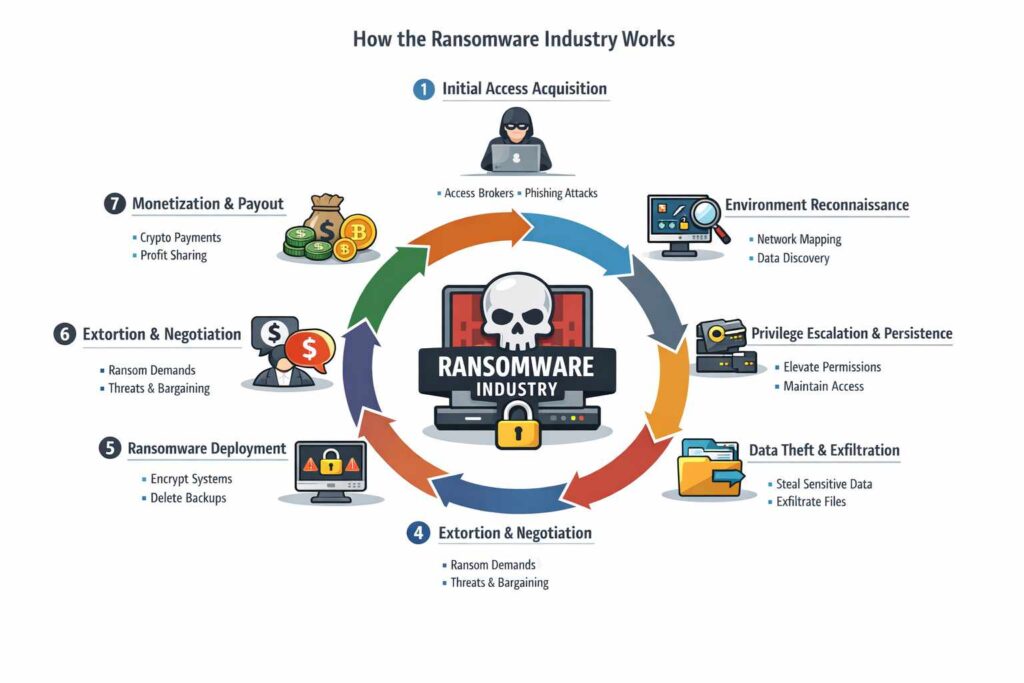
    Step by Step Breakdown of How Ransomware Industry Works

    To fully understand how ransomware industry works, it is important to analyze the lifecycle in stages. Each stage represents a distinct risk point and operational function.

    Step 1 Initial Access Acquisition

    The process begins with gaining access to a target environment.

    Threat actors often obtain access through intermediaries known as access brokers. These brokers sell credentials or entry points to ransomware groups.

    In other cases, affiliates gain access through phishing or exposed services. However, the key point is that access is often commoditized.

    This stage introduces risk because attackers already operate inside the environment before detection.

    Step 2 Environment Reconnaissance

    After access, attackers study the environment.

    They identify critical systems, backup locations, and sensitive data stores. In addition, they map user privileges and network structure.

    This phase allows attackers to plan their next move carefully. Therefore, they minimize noise and avoid early detection.

    Step 3 Privilege Expansion and Persistence

    Next, attackers expand their access.

    They move from initial entry points to more critical systems. At the same time, they establish persistence to maintain long term access.

    This ensures that even if one access point is removed, others remain active. As a result, attackers maintain control over the environment.

    Step 4 Data Collection and Exfiltration

    Before deploying ransomware, attackers often collect sensitive data.

    This includes intellectual property, financial records, and personal information. They may transfer this data to external infrastructure.

    This step supports double extortion strategies. Therefore, even if recovery is possible, data exposure remains a threat.

    Step 5 Ransomware Deployment

    Once preparation is complete, attackers deploy ransomware.

    The payload encrypts systems and disrupts operations. In addition, it may target backups to prevent recovery.

    At this stage, the organization experiences immediate impact. Therefore, response time becomes critical.

    Step 6 Extortion and Negotiation

    After encryption, attackers initiate communication.

    They demand payment in exchange for decryption and data protection. In many cases, negotiation specialists handle this process.

    These actors use psychological pressure and deadlines. As a result, victims face difficult decisions under stress.

    Step 7 Monetization and Revenue Sharing

    Finally, payments are processed through cryptocurrency systems.

    The revenue is shared among participants. Developers receive a portion, while affiliates keep a percentage.

    This model incentivizes continued activity. Therefore, ransomware remains a profitable and persistent threat.

    Detection Challenges

    Detecting ransomware operations is difficult due to their structured approach.

    First, attackers operate quietly during early stages. Reconnaissance and lateral movement generate minimal alerts.

    Second, legitimate tools are often used to avoid detection. This makes activity appear normal within the environment.

    In addition, encryption occurs quickly once triggered. Therefore, detection windows are limited.

    As a result, many organizations detect ransomware only after significant damage occurs.

    Why Traditional Defenses Fail

    Traditional defenses focus on perimeter security. However, ransomware attacks often begin inside the network.

    Once attackers gain access, they bypass external controls. In addition, trusted credentials reduce suspicion.

    Moreover, signature based detection struggles with evolving ransomware variants. Attackers frequently modify their tools.

    Therefore, traditional models fail to address modern ransomware tactics.

    Mitigation Strategies

    Organizations must adopt layered defenses to address how ransomware industry works.

    First, implement strong access controls. Limit privileges and monitor credential usage.

    Second, use continuous monitoring and behavioral analytics. This helps detect unusual activity early.

    Third, maintain secure and isolated backups. Ensure that recovery remains possible without paying ransom.

    In addition, conduct regular security assessments. Identify vulnerabilities before attackers exploit them.

    Finally, train employees to recognize phishing and social engineering attempts. Human awareness reduces initial access risks.

    Broader Security Implications

    The ransomware industry affects the entire cybersecurity landscape.

    It drives the growth of underground economies. In addition, it encourages collaboration among threat actors.

    Moreover, it increases pressure on organizations to invest in security. Regulatory bodies also respond with stricter requirements.

    As a result, ransomware shapes both defensive strategies and policy decisions.

    What Organizations Should Do Now

    Organizations should take immediate action to reduce exposure.

    First, assess current security posture and identify gaps.

    Second, implement zero trust principles to limit access.

    Third, improve incident response capabilities. Teams must respond quickly to minimize damage.

    In addition, engage with threat intelligence sources to stay informed. Structured frameworks and validation models can support consistent analysis and response .

    Finally, leadership must prioritize cybersecurity as a core business function.

    Conclusion

    Understanding how ransomware industry works provides valuable insight into modern cyber threats. This industry operates with structure, efficiency, and financial motivation.

    Each stage of the lifecycle introduces risk. From initial access to monetization, attackers exploit weaknesses systematically.

    Therefore, organizations must adopt proactive and layered defenses. Strong governance, monitoring, and awareness remain essential.

    FAQ

    What is how ransomware industry works

    It refers to the structured ecosystem of ransomware operations, including developers, affiliates, and monetization models.

    Why is ransomware so successful

    Ransomware succeeds due to its organized business model and ability to scale attacks through affiliates and shared tools.

    How do ransomware groups make money

    They generate revenue through ransom payments, often using cryptocurrency and revenue sharing models.

    How can organizations defend against ransomware

    Organizations should use strong access controls, continuous monitoring, secure backups, and employee training.

    Share. Facebook Twitter Pinterest LinkedIn Tumblr Email
    cyber security threat
    • Website

    Related Posts

    Anatomy of the Claude Code Leak: What 500,000 Lines of AI Code Reveal About Future Risks

    April 2, 2026

    Risk of Hiring Hackers from Dark Web

    April 1, 2026

    What to Do When You Are Hacked

    March 27, 2026

    Ransomware Campaign Targeting MFT Systems

    March 25, 2026

    Ivanti VPN Zero Day Exploitation: Active Threat, Impact, and Mitigation

    March 25, 2026

    Iranian Hackers Targeting CCTV Networks During Military Operations (2026)

    March 20, 2026
    Leave A Reply Cancel Reply

    Top Picks
    Editors Picks

    How Ransomware Industry Works

    April 3, 2026

    Anatomy of the Claude Code Leak: What 500,000 Lines of AI Code Reveal About Future Risks

    April 2, 2026

    Risk of Hiring Hackers from Dark Web

    April 1, 2026

    What to Do When You Are Hacked

    March 27, 2026
    Advertisement
    Demo
    About Us
    About Us

    Artificial Intelligence & AI, The Pulse of Cybersecurity Powered by AI.

    We're accepting new partnerships right now.

    Email Us: info@cybersecuritythreatai.com

    Our Picks

    Cybersecurity Marketing Strategy for Enterprise Growth

    February 17, 2026

    Cybersecurity Account Based Marketing Services

    December 22, 2025

    Cybersecurity Content Marketing Services

    December 22, 2025
    Top Reviews
    X (Twitter) YouTube LinkedIn
    • Home
    • AI Business Marketing Support
    • Cybersecurity Marketing Support
    © 2026 Cybersecurity threat & AI Designed by Cybersecurity threat & AI .

    Type above and press Enter to search. Press Esc to cancel.

    Grow your AI & Cybersecurity Business.
    Powered by Joinchat
    HiHello , welcome to cybersecuritythreatai.com, we bring reliable marketing support for ai and cybersecurity businesses.
    Can we help you?
    Open Chat