



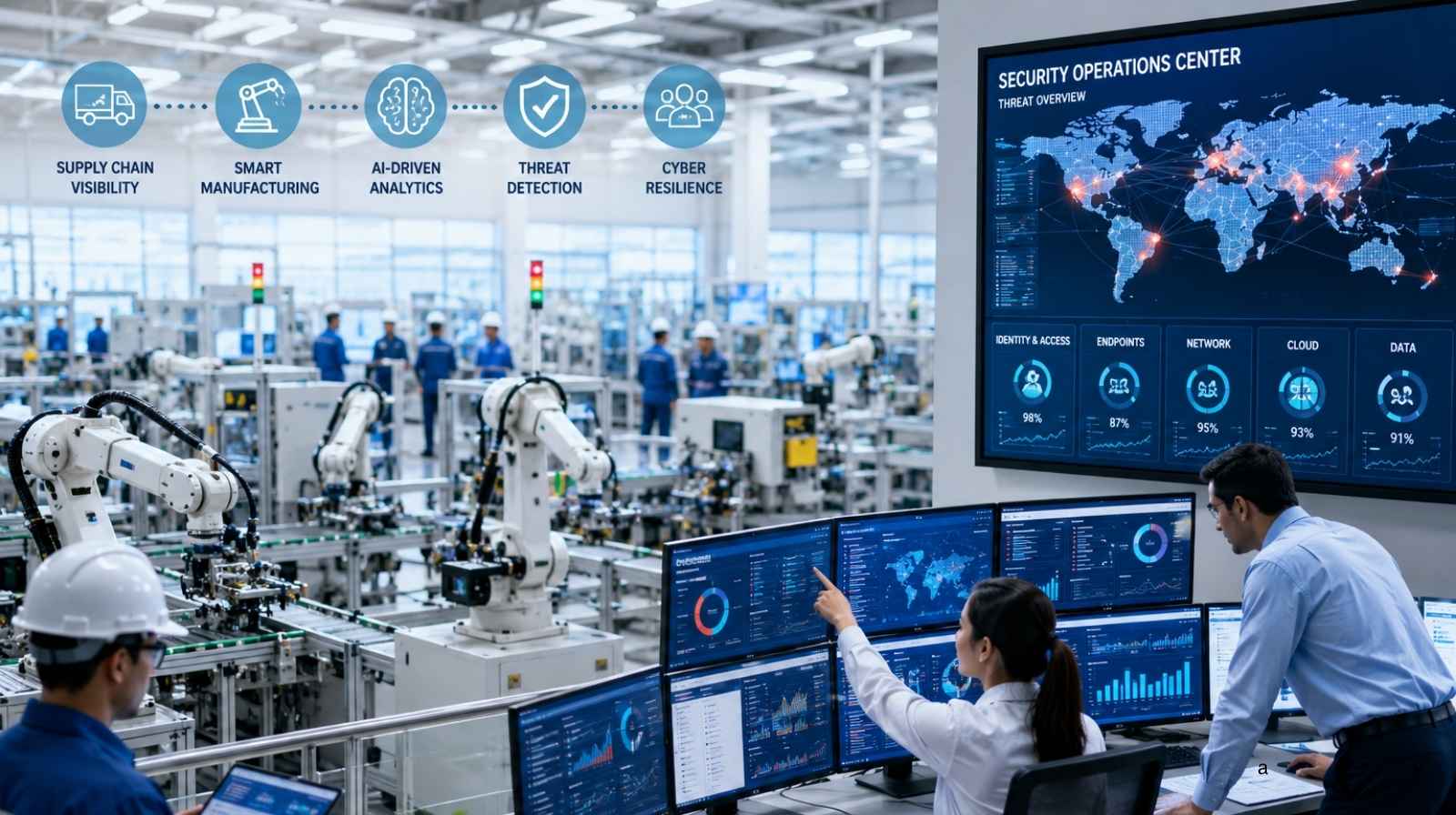
Manufacturing has become one of the most targeted industries for ransomware operators. Modern factories depend on connected systems, cloud platforms, engineering applications, suppliers, and global logistics networks. This digital transformation has improved efficiency. However, it has also expanded the attack surface.
The Tata Electronics ransomware incident demonstrates how quickly a cyberattack can become a business issue. The reported incident did not simply raise questions about data security. It also highlighted the growing cyber risk facing global manufacturing supply chains.
Manufacturers now protect far more than production lines. They safeguard intellectual property, customer information, supplier relationships, and years of engineering expertise. Every one of these assets attracts cybercriminals seeking financial gain through extortion.
For executives, the lesson is clear. Cybersecurity has become a boardroom discussion because operational resilience depends on it.
What We Know About the Incident
Public reporting indicates that Tata Electronics experienced a ransomware attack involving unauthorized access to corporate information. The threat actors claimed to have exfiltrated data before attempting extortion. At the time of writing, there is no public evidence that large scale manufacturing operations suffered prolonged disruption.
That distinction matters.
Modern ransomware groups increasingly steal information before they encrypt systems. Their objective is no longer limited to disrupting business operations. Instead, they seek leverage. Sensitive business information often provides more negotiating power than encrypted files alone.
This evolution reflects a broader trend across the ransomware ecosystem. Criminal groups have shifted from simple disruption to sophisticated data theft and extortion campaigns. Their methods continue to become more patient, targeted, and difficult to detect.
Why Manufacturing Has Become a High Value Target
Manufacturing organizations present an attractive opportunity for attackers because they combine valuable intellectual property with complex technology environments.
Most large manufacturers operate traditional information technology alongside operational technology. Engineering systems communicate with production equipment. Cloud applications connect with supplier portals. Remote users access business platforms from multiple locations.
Each connection improves productivity. Each connection also introduces additional cyber risk.
Many manufacturers also depend on hundreds or even thousands of suppliers across multiple countries. A single compromise can affect far more than one organization. It can influence production schedules, logistics, contractual commitments, and customer confidence.
For ransomware operators, this creates significant pressure on victims to restore operations quickly.
The Changing Nature of Ransomware
The public often associates ransomware with locked computer screens and inaccessible files. Today’s attacks rarely begin that way.
Modern threat actors frequently spend days or weeks inside an environment before launching the final stage of their operation. During that time, they study network architecture, identify privileged accounts, locate sensitive information, and understand business processes.
Many use legitimate administrative tools instead of custom malware. They authenticate with stolen credentials rather than exploiting software vulnerabilities. Their activity often resembles normal administrative work.
This approach makes detection considerably more difficult.
Security teams cannot rely solely on malware signatures or traditional indicators of compromise. They must identify subtle behavioral changes that reveal an attacker moving through the environment.
The Supply Chain Risk Is Growing
The Tata Electronics incident also reminds us that manufacturing organizations rarely operate in isolation.
A modern electronics manufacturer exchanges information with design partners, logistics providers, equipment vendors, software suppliers, distributors, and customers around the world.
Every trusted relationship expands the digital ecosystem.
An attacker who gains access to one organization may obtain information about many others. Even if production remains operational, stolen engineering documents, commercial agreements, supplier details, or customer information can create long term business consequences.
This reality has changed how executives should think about cyber risk.
Cybersecurity is no longer limited to protecting internal systems. It also requires visibility across trusted external relationships.
Why Early Detection Matters More Than Recovery
Many organizations continue investing heavily in backup strategies and disaster recovery. Those capabilities remain essential. However, they address the final stage of a ransomware attack rather than the beginning.
The greater opportunity lies in detecting attackers before they complete their objectives.
Most ransomware campaigns generate warning signs long before encryption begins. An attacker may authenticate from an unusual location. A privileged account may suddenly access systems it has never used before. Large volumes of sensitive information may move unexpectedly across the network.
Individually, these events may appear harmless.
Viewed together, they often reveal an active intrusion.
Organizations that identify these patterns early can interrupt the attack before sensitive information leaves the environment or ransomware is deployed.
Detection speed has become one of the most important measures of cyber resilience.
The Executive Lessons
The Tata Electronics ransomware incident reinforces several important lessons for business leaders.
First, identity has become the primary attack surface. Stolen credentials often provide easier access than software exploits.
Second, visibility matters more than volume. Security teams collect enormous amounts of telemetry every day. The challenge is understanding which events deserve immediate attention.
Third, cyber resilience extends beyond technology. Governance, supplier oversight, incident response planning, and executive decision making all influence the outcome of a security incident.
Finally, organizations should assume that sophisticated attackers will eventually gain initial access. Security strategies should focus on limiting movement, detecting abnormal behavior, and reducing the time required to respond.
Where Gurucul Strengthens Enterprise Cyber Resilience
Preventing every intrusion is unrealistic. Detecting malicious activity before it becomes a business crisis is a more achievable objective.
This is where modern security analytics platforms can provide significant value.
Gurucul approaches security operations by combining behavioral analytics, artificial intelligence, identity intelligence, and risk based prioritization into a unified platform. Rather than relying only on predefined attack signatures, its capabilities are designed to identify abnormal activity that may indicate an evolving compromise.
For organizations facing ransomware threats, this approach aligns with how modern attacks unfold.
Gurucul Next Gen SIEM helps security teams correlate activity across cloud environments, endpoints, networks, identity platforms, and business applications. Instead of examining isolated alerts, analysts gain broader context around suspicious activity. This context helps reduce investigation time while improving confidence in security decisions.
Its User and Entity Behavior Analytics capability focuses on behavior rather than signatures alone. If an employee account suddenly accesses engineering repositories it has never used before, or an administrator performs unusual actions outside established patterns, those deviations can be highlighted for investigation. This becomes increasingly valuable when attackers rely on stolen credentials instead of malware.
The AI SOC Analyst extends these capabilities by assisting security teams during investigations. Modern security operations centers receive overwhelming numbers of alerts every day. Automated investigation and contextual analysis help analysts prioritize incidents that present genuine business risk. This allows experienced responders to spend more time containing threats rather than reviewing routine alerts.
Data Pipeline Management addresses another challenge often overlooked by executives. Large enterprises generate massive volumes of security telemetry from many different technologies. Collecting, normalizing, and managing that information efficiently improves visibility while controlling operational complexity. Better data quality ultimately supports better security decisions.
Gurucul also provides Insider Risk Management capabilities that complement external threat detection. Not every significant data exposure results from external attackers. Compromised privileged accounts or malicious insiders can create similar business consequences. Monitoring sensitive data access and unusual user behavior helps organizations reduce that risk without disrupting normal business operations.
Together, these capabilities support a security strategy focused on early detection, faster investigation, and informed response. They do not replace sound governance, strong identity controls, or disciplined security practices. Instead, they strengthen an organization’s ability to identify sophisticated attacks before they escalate into major business incidents.
Looking Beyond This Incident
The Tata Electronics ransomware incident should not be viewed as an isolated event. It reflects a broader change in the cyber threat landscape affecting manufacturers worldwide.
Attackers increasingly pursue intellectual property, commercial information, and strategic business data instead of relying only on operational disruption. Their techniques continue to evolve because organizations have improved their defenses against traditional ransomware campaigns.
Manufacturers therefore need security strategies that evolve just as quickly.
Technology remains an important part of that strategy, but success depends equally on leadership, governance, visibility, and preparedness. Organizations that invest in continuous monitoring, behavioral analytics, identity security, and disciplined incident response place themselves in a stronger position to withstand future attacks.
Cyber resilience is no longer measured only by how quickly systems recover. It is measured by how effectively organizations detect, understand, and contain threats before they become business crises.
The Tata Electronics incident serves as a timely reminder that protecting digital manufacturing ecosystems requires constant vigilance. As global supply chains become more interconnected, cybersecurity will continue to shape operational resilience, competitive advantage, and long term business trust.