



Gurucul Named a Leader in the 2025 Gartner Magic Quadrant TM for SIEM 

Read the Report
Close Menu
Cybersecurity Threat & Artificial Intelligence

    Subscribe to Updates

    Get the latest creative news from FooBar about art, design and business.

    loader

    Email Address*

    FIRSTNAME

    LASTNAME

    What's Hot

    Introducing the Global Insider Threat Tracker: 15 Years of Historical Insider Risk Data

    August 14, 2026

    Systemic Vulnerabilities in Critical Infrastructure: Threat Intelligence Analysis of Multi-State Cyber Campaign Targeting Water and Wastewater Operational Technology

    August 13, 2026

    Hardware Hacking Gadgets in 2026: Flipper Zero, HackRF and WiFi Tools

    August 8, 2026
    X (Twitter) YouTube
    Cybersecurity Threat & Artificial IntelligenceCybersecurity Threat & Artificial Intelligence
    • Home
      • Cybersecurity Glossary
      • AI Glossary
    • Cybersecurity
      1. Cyber Threat Intelligence
      2. Hacking attacks
      3. Common Vulnerabilities & Exposures
      4. Threat Intel
      5. Insider Threat Updates
      6. Attack Matrix
      7. Threat Actors
      8. View All

      Introducing the Global Insider Threat Tracker: 15 Years of Historical Insider Risk Data

      August 14, 2026

      Systemic Vulnerabilities in Critical Infrastructure: Threat Intelligence Analysis of Multi-State Cyber Campaign Targeting Water and Wastewater Operational Technology

      August 13, 2026

      Top 10 Russian-Linked Threat Actors Security Teams Should Monitor

      August 7, 2026

      Navigating the New Frontier: Securing Enterprises Against Threats to AI Platforms

      July 31, 2026

      Systemic Vulnerabilities in Critical Infrastructure: Threat Intelligence Analysis of Multi-State Cyber Campaign Targeting Water and Wastewater Operational Technology

      August 13, 2026

      Top 10 Russian-Linked Threat Actors Security Teams Should Monitor

      August 7, 2026

      Bank of Baroda Data Breach 2026: Threat Intelligence Assessment, Attack Reconstruction & Defensive Lessons

      July 28, 2026

      The Shadow Insider: How AI Agents Are Becoming the New Insider Risk Nobody Is Monitoring

      July 15, 2026

      CVE 2026 12569: Inside the Exploitation of PTC Windchill

      August 8, 2026

      CVE 2026 31431: The Linux Copy Fail Vulnerability and Root Access Risk

      August 8, 2026

      CVE 2026 0300: How the PAN OS Zero Day Exposed Enterprise Firewalls

      August 8, 2026

      Top CVEs to Watch in July 2025: AI-Driven Threats and Exploits You Can’t Ignore

      July 8, 2025

      Introducing the Global Insider Threat Tracker: 15 Years of Historical Insider Risk Data

      August 14, 2026

      Systemic Vulnerabilities in Critical Infrastructure: Threat Intelligence Analysis of Multi-State Cyber Campaign Targeting Water and Wastewater Operational Technology

      August 13, 2026

      Hardware Hacking Gadgets in 2026: Flipper Zero, HackRF and WiFi Tools

      August 8, 2026

      AirKey: How WiFi Sensing Can Be Used to Infer Device PINs

      August 8, 2026

      Introducing the Global Insider Threat Tracker: 15 Years of Historical Insider Risk Data

      August 14, 2026

      Systemic Vulnerabilities in Critical Infrastructure: Threat Intelligence Analysis of Multi-State Cyber Campaign Targeting Water and Wastewater Operational Technology

      August 13, 2026

      Hardware Hacking Gadgets in 2026: Flipper Zero, HackRF and WiFi Tools

      August 8, 2026

      AirKey: How WiFi Sensing Can Be Used to Infer Device PINs

      August 8, 2026

      Introducing the Global Insider Threat Tracker: 15 Years of Historical Insider Risk Data

      August 14, 2026

      Systemic Vulnerabilities in Critical Infrastructure: Threat Intelligence Analysis of Multi-State Cyber Campaign Targeting Water and Wastewater Operational Technology

      August 13, 2026

      Hardware Hacking Gadgets in 2026: Flipper Zero, HackRF and WiFi Tools

      August 8, 2026

      AirKey: How WiFi Sensing Can Be Used to Infer Device PINs

      August 8, 2026

      Introducing the Global Insider Threat Tracker: 15 Years of Historical Insider Risk Data

      August 14, 2026

      Systemic Vulnerabilities in Critical Infrastructure: Threat Intelligence Analysis of Multi-State Cyber Campaign Targeting Water and Wastewater Operational Technology

      August 13, 2026

      Hardware Hacking Gadgets in 2026: Flipper Zero, HackRF and WiFi Tools

      August 8, 2026

      AirKey: How WiFi Sensing Can Be Used to Infer Device PINs

      August 8, 2026

      The Silent Cyber War for Memory: Why Attackers Are Targeting AI Context Instead of Endpoints

      July 17, 2026

      The Shadow Insider: How AI Agents Are Becoming the New Insider Risk Nobody Is Monitoring

      July 15, 2026

      How to Identify Fake Income Tax Emails & Spot Tax Scams

      June 26, 2026

      How AI-Driven Threat Detection Could Have Reduced the Impact of the Bajaj Auto Ransomware Attack

      June 25, 2026
    • AI
      1. AI‑Driven Threat Detection
      2. AI‑Powered Defensive Tools
      3. AI‑Threats & Ethics
      4. AI Security Architecture
      5. AI Security Information Tool
      6. AI Fraud Risk Scanner
      7. View All

      Navigating the New Frontier: Securing Enterprises Against Threats to AI Platforms

      July 31, 2026

      Every Major AI Agent Security Incident Since the Rise of Agentic AI (2025–2026)

      July 24, 2026

      The Silent Cyber War for Memory: Why Attackers Are Targeting AI Context Instead of Endpoints

      July 17, 2026

      AI Assisted Cyberattack Marks a Turning Point in Cybersecurity

      May 15, 2026

      The Silent Cyber War for Memory: Why Attackers Are Targeting AI Context Instead of Endpoints

      July 17, 2026

      The Shadow Insider: How AI Agents Are Becoming the New Insider Risk Nobody Is Monitoring

      July 15, 2026

      Project Glasswing and AI Model Mythos: The Next Evolution in AI Driven Cyber Threats

      April 22, 2026

      Emerging AI-Driven Threats and Defensive Shifts in 2026

      January 7, 2026

      The Ethics of AI Threat Detection: Balancing Security, Privacy and Accountability

      August 8, 2026

      Navigating the New Frontier: Securing Enterprises Against Threats to AI Platforms

      July 31, 2026

      Every Major AI Agent Security Incident Since the Rise of Agentic AI (2025–2026)

      July 24, 2026

      The Silent Cyber War for Memory: Why Attackers Are Targeting AI Context Instead of Endpoints

      July 17, 2026

      Introducing the Global Insider Threat Tracker: 15 Years of Historical Insider Risk Data

      August 14, 2026

      Systemic Vulnerabilities in Critical Infrastructure: Threat Intelligence Analysis of Multi-State Cyber Campaign Targeting Water and Wastewater Operational Technology

      August 13, 2026

      Hardware Hacking Gadgets in 2026: Flipper Zero, HackRF and WiFi Tools

      August 8, 2026

      AirKey: How WiFi Sensing Can Be Used to Infer Device PINs

      August 8, 2026

      Introducing the Global Insider Threat Tracker: 15 Years of Historical Insider Risk Data

      August 14, 2026

      Systemic Vulnerabilities in Critical Infrastructure: Threat Intelligence Analysis of Multi-State Cyber Campaign Targeting Water and Wastewater Operational Technology

      August 13, 2026

      Hardware Hacking Gadgets in 2026: Flipper Zero, HackRF and WiFi Tools

      August 8, 2026

      AirKey: How WiFi Sensing Can Be Used to Infer Device PINs

      August 8, 2026

      Introducing the Global Insider Threat Tracker: 15 Years of Historical Insider Risk Data

      August 14, 2026

      Systemic Vulnerabilities in Critical Infrastructure: Threat Intelligence Analysis of Multi-State Cyber Campaign Targeting Water and Wastewater Operational Technology

      August 13, 2026

      Hardware Hacking Gadgets in 2026: Flipper Zero, HackRF and WiFi Tools

      August 8, 2026

      AirKey: How WiFi Sensing Can Be Used to Infer Device PINs

      August 8, 2026

      AI Assisted Cyberattack Marks a Turning Point in Cybersecurity

      May 15, 2026

      Narrative Warfare: How India Is Being Targeted, How Pakistan Operates It, and What India Must Do to Fight Back

      November 26, 2025

      Cyber Wars, Cyber Threats, and Cybersecurity Will Push Gold Higher

      October 20, 2025

      The Surge in AI Deepfake Enabled Social Engineering

      September 10, 2025
    • News
      1. News
      2. Tech
      3. Gadgets
      4. View All

      Introducing the Global Insider Threat Tracker: 15 Years of Historical Insider Risk Data

      August 14, 2026

      Systemic Vulnerabilities in Critical Infrastructure: Threat Intelligence Analysis of Multi-State Cyber Campaign Targeting Water and Wastewater Operational Technology

      August 13, 2026

      Hardware Hacking Gadgets in 2026: Flipper Zero, HackRF and WiFi Tools

      August 8, 2026

      AirKey: How WiFi Sensing Can Be Used to Infer Device PINs

      August 8, 2026

      The Silent Cyber War for Memory: Why Attackers Are Targeting AI Context Instead of Endpoints

      July 17, 2026

      The Shadow Insider: How AI Agents Are Becoming the New Insider Risk Nobody Is Monitoring

      July 15, 2026

      How to Identify Fake Income Tax Emails & Spot Tax Scams

      June 26, 2026

      How AI-Driven Threat Detection Could Have Reduced the Impact of the Bajaj Auto Ransomware Attack

      June 25, 2026

      Hardware Hacking Gadgets in 2026: Flipper Zero, HackRF and WiFi Tools

      August 8, 2026

      AirKey: How WiFi Sensing Can Be Used to Infer Device PINs

      August 8, 2026

      Smartwatch Hacking: How GPS Wearables Can Expose Users to Attackers

      August 8, 2026

      Flipper Zero 2026: How New Hacking Hardware Expands the Attack Surface

      August 8, 2026

      Gurucul Announces New AI Security Innovations at Black Hat USA 2026

      August 4, 2026

      Bank of Baroda Data Breach 2026: Threat Intelligence Assessment, Attack Reconstruction & Defensive Lessons

      July 28, 2026

      How to Identify Fake Income Tax Emails & Spot Tax Scams

      June 26, 2026

      How AI-Driven Threat Detection Could Have Reduced the Impact of the Bajaj Auto Ransomware Attack

      June 25, 2026
    • Marketing
      1. Cybersecurity Marketing
      2. AI Business Marketing
      3. Case Studies
      4. View All

      Cybersecurity Marketing Strategy for Enterprise Growth

      February 17, 2026

      Cybersecurity Account Based Marketing Services

      December 22, 2025

      Cybersecurity Content Marketing Services

      December 22, 2025

      Cybersecurity Digital Marketing Services

      December 22, 2025

      Cybersecurity Marketing Strategy for Enterprise Growth

      February 17, 2026

      How a Cybersecurity SaaS Grew From 0 to 100 Enterprise Clients in 12 Months

      December 3, 2025

      Why Most AI Startups Fail at Marketing

      June 29, 2025

      Introducing the Global Insider Threat Tracker: 15 Years of Historical Insider Risk Data

      August 14, 2026

      Systemic Vulnerabilities in Critical Infrastructure: Threat Intelligence Analysis of Multi-State Cyber Campaign Targeting Water and Wastewater Operational Technology

      August 13, 2026

      Hardware Hacking Gadgets in 2026: Flipper Zero, HackRF and WiFi Tools

      August 8, 2026

      AirKey: How WiFi Sensing Can Be Used to Infer Device PINs

      August 8, 2026

      Cybersecurity Marketing Strategy for Enterprise Growth

      February 17, 2026

      Cybersecurity Account Based Marketing Services

      December 22, 2025

      Cybersecurity Content Marketing Services

      December 22, 2025

      Cybersecurity Digital Marketing Services

      December 22, 2025
    • Products
      • Tools
        • Cybersecurity Tools
        • Threat Content Analyzer
        • Password Generator
        • Enterprise Cybersecurity Maturity Assessment
        • Cybersecurity Maturity Assessment
        • Password Strength Checker
        • Hash Generator
        • Base64 Encoder/Decoder
        • Risk Matrix
        • IPv4 Subnet Calculator
        • IPv6 Subnet Calculator
      • SIEM
      • SOC
    • Contact
    X (Twitter) YouTube LinkedIn
    Cybersecurity Threat & Artificial Intelligence
    Home » Risk of Hiring Hackers from Dark Web
    Cybersecurity

    Risk of Hiring Hackers from Dark Web

    Omkar Nath NandiBy Omkar Nath NandiApril 1, 2026Updated:July 28, 2026No Comments7 Mins Read
    Facebook Twitter Pinterest Telegram LinkedIn Tumblr WhatsApp Email
    Risk of Hiring Hackers from Dark Web Explained
    Risk of Hiring Hackers from Dark Web Explained
    Share
    Facebook Twitter LinkedIn Pinterest Telegram Email

    The risk of hiring hackers from dark web extends far beyond legal concerns. It introduces measurable cybersecurity risks that can be analyzed using structured threat metrics. Many organizations assume they can control these engagements. However, in practice, they expose themselves to long term exploitation, tracking, and blackmail.

    This article breaks down the risk using a step by step risk model. It also explains where these actors are sourced, who hires them, and how attackers later turn the relationship into leverage.
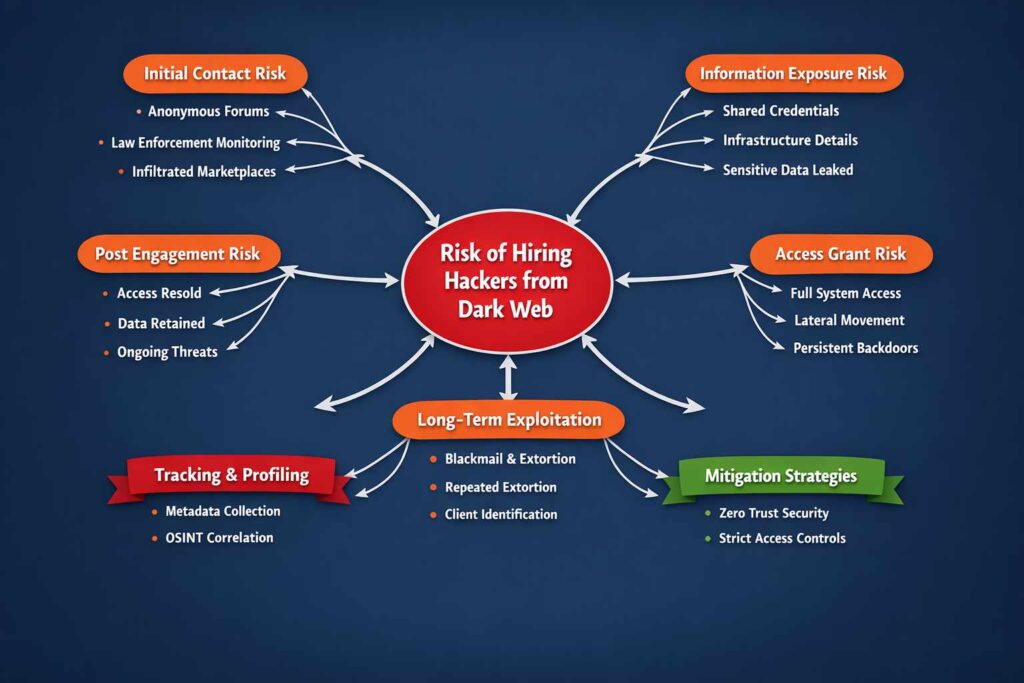
    Step by Step Risk Metrics Model

    To understand the risk of hiring hackers from dark web, we can break it into measurable components. Each stage increases exposure and reduces control.

    Step 1 Initial Contact Risk

    At this stage, the organization initiates contact through hidden marketplaces or forums.

    Risk factors include anonymity, lack of verification, and exposure to law enforcement monitoring. In addition, many of these platforms are infiltrated by threat intelligence teams.

    Risk score tends to be medium to high because attribution begins here.

    Step 2 Information Exposure Risk

    Next, the hiring party shares requirements and sometimes sensitive data.

    This may include credentials, infrastructure details, or business context. As a result, the attacker gains valuable intelligence even before any action occurs.

    Risk score increases to high due to potential insider level visibility.

    Step 3 Access Grant Risk

    At this stage, access is provided directly or indirectly.

    This is the most critical phase. The attacker now operates with trusted privileges. Therefore, they can move laterally, collect data, or establish persistence.

    Risk score becomes critical because full compromise is possible.

    Step 4 Post Engagement Risk

    Even if the task appears complete, risk does not end.

    Attackers often retain access or sell it to others. In addition, they may store collected data for future use.

    Risk remains critical due to ongoing exposure.

    Step 5 Long Term Exploitation Risk

    Over time, attackers may exploit the relationship.

    This includes blackmail, extortion, or targeted attacks. Therefore, the initial decision creates a persistent threat vector.

    Risk score remains critical and difficult to eliminate.

    Where These Hackers Are Sourced

    Dark web hackers are typically sourced from underground ecosystems. These include closed forums, invite only communities, and marketplace platforms.

    Many of these environments operate on reputation systems. However, these ratings are often manipulated or unreliable.

    In addition, some actors pose as professionals while actually running scams. Others are part of organized cybercrime groups offering services such as ransomware deployment or credential harvesting.

    Threat intelligence sources consistently observe these ecosystems through controlled monitoring and infiltration . These observations confirm that most actors operate with criminal intent rather than professional ethics.

    Who Hires Dark Web Hackers

    The demand side is diverse.

    Some individuals seek personal data or account access. Others attempt corporate espionage or competitive advantage.

    In certain cases, insiders within organizations engage hackers to bypass internal controls. This creates a hybrid threat combining insider risk and external attack capability.

    However, many who hire these actors underestimate the consequences. They assume a transactional relationship, while the attacker sees a long term opportunity.

    How Attackers Track Their Clients

    Once contact is established, attackers begin passive tracking.

    First, they collect metadata from communication channels. This may include timing patterns, language use, and operational behavior.

    Second, they analyze shared information such as IP ranges or infrastructure details. Even limited data can help identify the organization.

    Third, attackers often correlate information across multiple sources. This includes open source intelligence and previous engagements.

    As a result, anonymity is rarely guaranteed. Over time, attackers build a profile of the hiring entity.

    Blackmail and Extortion Scenarios

    Blackmail is one of the most common outcomes.

    After gaining access or completing a task, the attacker may threaten to expose the engagement. This creates legal and reputational pressure.

    In addition, attackers may demonstrate proof of access. For example, they may reveal partial data or system control.

    This forces the organization into a difficult position. Paying the attacker does not guarantee safety. In many cases, it leads to repeated extortion.

    Moreover, attackers may sell the information to other groups. This increases the scale of the threat.

    Detection Challenges in These Scenarios

    Detection becomes complex because the activity often blends with legitimate operations.

    Since access is granted intentionally, security tools may not flag anomalies immediately.

    In addition, attackers avoid noisy techniques. They prefer low visibility methods that extend access over time.

    Therefore, organizations often detect the issue only after blackmail or data leakage occurs.

    Why Traditional Security Models Break

    Traditional models rely on trust boundaries. However, hiring a hacker breaks these boundaries completely.

    The attacker operates inside the trusted zone. Therefore, perimeter defenses become ineffective.

    In addition, logging and monitoring systems may interpret actions as authorized. This creates blind spots in detection.

    As a result, even mature security programs may fail to respond in time.

    Mitigation Strategies Based on Risk Metrics

    Organizations should map mitigation to each risk stage.

    At the initial stage, strict policies must prevent any engagement with unauthorized actors.

    During information handling, sensitive data must never be shared outside controlled environments.

    At the access level, zero trust principles should limit privilege exposure.

    For long term risk, continuous monitoring and threat hunting are essential. Behavioral analytics can identify unusual patterns even when credentials appear valid.

    In addition, legal and compliance teams must be involved early. This ensures alignment with regulations and reduces exposure.

    Broader Security Implications

    The broader impact includes increased attack surface, regulatory scrutiny, and reputational damage.

    Organizations may also become part of larger cybercrime ecosystems. Once identified, they can be targeted repeatedly.

    Furthermore, trust with customers and partners may decline. This affects long term business stability.

    What Organizations Should Do Now

    Organizations should act immediately to reduce exposure.

    First, audit any past or current interactions with unknown third parties.

    Second, strengthen access controls and monitoring systems.

    Third, invest in ethical security services such as certified penetration testing.

    In addition, leadership must enforce a clear stance against engaging with cybercriminals.

    Finally, organizations should align with structured threat intelligence frameworks to improve visibility and response .


    The Critical Role of Insider Risk Management in Modern Cybersecurity

    The growing sophistication of cyber threats has made insider risk a critical concern for organizations, especially when engaging with talent sourced from unverified environments like the dark web. Unlike external attackers, insiders or hired individuals with malicious intent already have access to systems, credentials, and sensitive data, making their actions harder to detect. Cybercriminal groups are increasingly known to recruit or collaborate with insiders, enabling deeper infiltration and more damaging attacks such as data theft, ransomware deployment, and intellectual property compromise.

    This is where a robust insider risk management strategy becomes essential. Organizations must move beyond traditional perimeter security and adopt behavioral analytics, continuous monitoring, and AI driven threat detection to identify anomalies in user activity. Effective insider risk management helps detect compromised or malicious users early and reduces risks associated with third party hires and contractors. In a landscape where anonymous actors and hired hackers operate with increasing sophistication, proactive monitoring and intelligent risk detection have become a foundational requirement for enterprise security.

    Conclusion

    The risk of hiring hackers from dark web is measurable, predictable, and highly dangerous. Each stage of engagement increases exposure and reduces control.

    What begins as a simple request often evolves into long term exploitation, tracking, and blackmail. Therefore, organizations must avoid these practices entirely and rely on trusted security methods.

    FAQ

    What is the biggest risk of hiring hackers from dark web

    The biggest risk is loss of control over systems and data, followed by blackmail and legal consequences.

    Can hackers track the people who hire them

    Yes, attackers can collect metadata and correlate information to identify their clients over time.

    Why does blackmail happen after hiring a hacker

    Because attackers gain leverage through access or sensitive data, which they use to demand further payments.

    How can organizations prevent these risks

    They should avoid dark web engagements, enforce strict policies, and use trusted cybersecurity professionals.

    Share. Facebook Twitter Pinterest LinkedIn Tumblr Email
    Omkar Nath Nandi
    Omkar Nath Nandi
    • Website
    • Facebook
    • X (Twitter)
    • Instagram
    • LinkedIn

    CBAP® | 17+ Yrs Full Stack Marketing | AI Strategist | Built 200+ AI Tools | Product Marketing (SaaS/B2B/B2C) | SEO & Perf | Trained 100k+ | IIT & IIM Guest Faculty

    Related Posts

    Introducing the Global Insider Threat Tracker: 15 Years of Historical Insider Risk Data

    August 14, 2026

    Systemic Vulnerabilities in Critical Infrastructure: Threat Intelligence Analysis of Multi-State Cyber Campaign Targeting Water and Wastewater Operational Technology

    August 13, 2026

    Top 10 Russian-Linked Threat Actors Security Teams Should Monitor

    August 7, 2026

    Navigating the New Frontier: Securing Enterprises Against Threats to AI Platforms

    July 31, 2026

    Bank of Baroda Data Breach 2026: Threat Intelligence Assessment, Attack Reconstruction & Defensive Lessons

    July 28, 2026

    Every Major AI Agent Security Incident Since the Rise of Agentic AI (2025–2026)

    July 24, 2026
    Leave A Reply Cancel Reply

    Search
    Contact
    Cybersecurity Consultation

    Talk to a Cybersecurity Expert

    Get expert guidance on threat intelligence, malware analysis, incident response, ransomware protection, vulnerability assessments, and enterprise cybersecurity.

      Editors Picks

      Introducing the Global Insider Threat Tracker: 15 Years of Historical Insider Risk Data

      August 14, 2026

      Systemic Vulnerabilities in Critical Infrastructure: Threat Intelligence Analysis of Multi-State Cyber Campaign Targeting Water and Wastewater Operational Technology

      August 13, 2026

      Hardware Hacking Gadgets in 2026: Flipper Zero, HackRF and WiFi Tools

      August 8, 2026

      AirKey: How WiFi Sensing Can Be Used to Infer Device PINs

      August 8, 2026
      Top Picks
      Advertisement
      Demo
      About Us
      About Us

      Artificial Intelligence & AI, The Pulse of Cybersecurity Powered by AI.

      We're accepting new partnerships right now.

      Email Us: info@cybersecuritythreatai.com

      Our Picks

      Cybersecurity Marketing Strategy for Enterprise Growth

      February 17, 2026

      Cybersecurity Account Based Marketing Services

      December 22, 2025

      Cybersecurity Content Marketing Services

      December 22, 2025
      Top Reviews
      X (Twitter) YouTube LinkedIn
      • Password Reset
      • Account
      • Logout
      • Members
      • Register
      • Login
      • User
      © 2026 Cybersecurity threat & AI Designed by Cybersecurity threat & AI .

      Type above and press Enter to search. Press Esc to cancel.